7 Insurance Coverages Louisiana Homeowners Often Think They Have But May Not
By Kati Cheek | Cheek Insurance Services | Metairie, Louisiana
When you buy homeowners insurance in Louisiana, it is easy to assume that if something damages your home, your policy will take care of it.
Unfortunately, homeowners insurance does not cover every type of loss.
In Louisiana, that distinction is especially important. Hurricanes, heavy rainfall, flooding, wind damage, aging roofs, drainage problems, and other risks can expose gaps in coverage that homeowners may not discover until they need to file a claim.
The Louisiana Department of Insurance reminds homeowners that a policy only provides coverage when a loss is caused by a peril covered by that specific policy. In other words, simply having homeowners insurance does not mean every type of damage to your home is insured.
As a Louisiana insurance agent, one of the most important conversations I can have with a homeowner is not simply, “Do you have homeowners insurance?”
It is:
“Do you know what your homeowners insurance actually covers?”
Here are seven areas Louisiana homeowners should review.
1. Flood Insurance
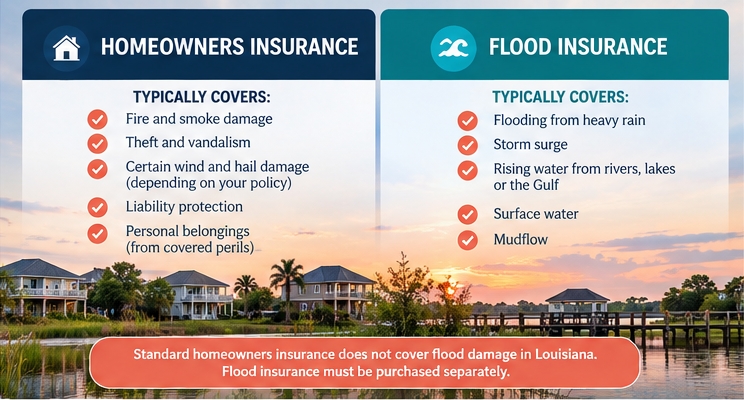
Does homeowners insurance cover flooding in Louisiana?
Generally, no. Standard homeowners insurance does not cover flood damage.
This is one of the most important insurance distinctions for Louisiana homeowners to understand.
The Louisiana Department of Insurance specifically states that flood damage is not covered under homeowners policies. Louisiana residents can instead purchase separate flood insurance through the National Flood Insurance Program (NFIP), private insurers, or surplus lines insurers.
Flooding can include water entering a home because of conditions such as rising water, overflowing waterways, heavy rainfall, and storm surge, depending on the applicable policy definition.
That means damage caused by a hurricane can potentially involve two very different insurance policies.
For example:
Wind damages your roof: Your homeowners or wind coverage may apply, depending on your policy.
Rising water enters your house: That damage may require flood insurance.
The fact that both happened during the same storm does not necessarily mean they are covered by the same policy.
“But I don't live in a high-risk flood zone.”
That does not mean your property has zero flood risk.
The NFIP reports that from 2014 through 2024, almost one-third of its flood claims came from areas outside designated high-risk flood areas.
Some mortgage lenders require flood insurance for properties in certain high-risk areas, but lender requirements should not be confused with whether a property can flood.
What Louisiana homeowners should check:
Look at your current insurance documents and determine whether you actually have a separate flood insurance policy.
If you do, review both your building coverage and contents coverage, because these are separate components of an NFIP policy.
2. Water Backup and Sewer Backup Coverage
Does homeowners insurance cover a sewer or drain backup?
Not necessarily.
This is where homeowners can easily confuse different types of water damage.
A broken pipe inside your house, rainwater entering through storm damage, floodwater rising from outside, and water backing up through a drain are not necessarily treated the same way by an insurance policy.
Water or sewer backup coverage may be available as an endorsement or additional coverage depending on the insurance carrier and policy.
For example, imagine heavy rain overwhelms drainage around your property and water backs up through a drain into part of your home.
A homeowner may simply see “water damage.”
The insurance policy, however, looks at where the water came from and what caused it.
Flood policies can have their own rules as well. The NFIP explains that a sewer backup directly caused by flooding can potentially qualify as flood damage, while a backup caused by something such as clogged pipes would not be covered by the NFIP for that reason.
This is why Louisiana homeowners should not assume that “water damage is water damage.”
It isn't that simple from an insurance standpoint.
Ask your agent:
“Does my homeowners policy include water or sewer backup coverage, and what situations does that coverage actually apply to?”
3. Full Replacement Cost for Your Roof
If my roof is damaged, will insurance pay for a brand-new roof?
That depends on how your roof is insured.
One of the biggest misunderstandings homeowners can have is assuming that having roof coverage automatically means the insurance company will pay the entire cost of replacing an old roof after a covered loss.
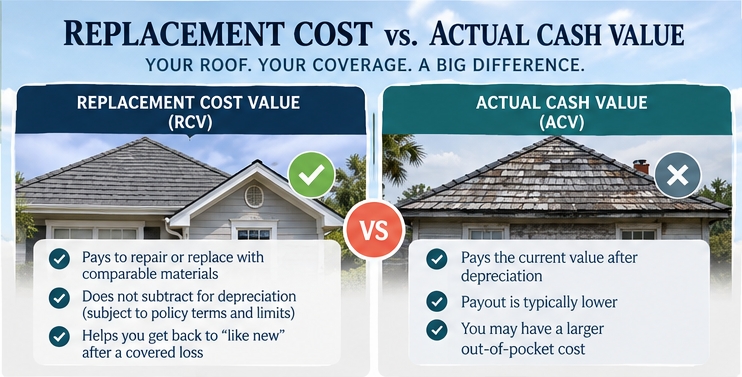
There is an important difference between Replacement Cost Value (RCV) and Actual Cash Value (ACV).
Replacement cost generally considers the cost of replacing or repairing damaged property with comparable materials without deducting for age and normal depreciation, subject to the terms and limits of the policy.
Actual cash value generally accounts for depreciation.
The Louisiana Department of Insurance specifically advises homeowners to determine which method their policy uses. LDI also warns that even a replacement-cost homeowners policy may have different limitations for roofs and certain exterior surfaces. In some policies, the home may have replacement-cost coverage while the roof is settled using actual cash value.
Consider a simplified example.
Suppose an older roof suffers covered storm damage and costs $20,000 to replace.
A homeowner might expect:
Replacement cost: $20,000
Minus deductible = insurance pays the remainder
But an ACV settlement may also account for depreciation based on the roof's age and condition.
That can create a much larger out-of-pocket expense than the homeowner expected.
For Louisiana homes exposed to hurricanes, wind, hail, and severe storms, this distinction can matter significantly.
Ask your agent:
“Is my roof insured at replacement cost or actual cash value, and are there any roof schedules, age restrictions, cosmetic exclusions, or special deductibles I should know about?”
4. Wind and Hail Coverage
Does Louisiana homeowners insurance automatically cover hurricane wind damage?
Often, but not always.
Wind damage is commonly included in homeowners policies, but Louisiana homeowners should never assume that it is automatically included in every policy.
The Louisiana Department of Insurance has specifically warned that some homeowners policies, particularly for properties along the coast, may exclude wind and hail damage.
That means a homeowner can technically have a homeowners insurance policy while needing separate protection for wind-related losses.
Even when wind is covered, another important issue remains:
Your hurricane, named-storm, or wind-and-hail deductible.
These deductibles can work differently from the standard deductible on your policy.
The Louisiana Department of Insurance reported in 2026 that homeowners named-storm or hurricane deductibles are typically in the range of 2% to 5% of the home's insured value.
For example, if your home is insured for $300,000 and your applicable hurricane deductible is 5%, that represents:
$15,000
That is dramatically different from assuming you have a $1,000 or $2,500 deductible.
Louisiana law also specifically addresses separate hurricane, named-storm, and wind-and-hail deductibles.
Before hurricane season, homeowners should know both:
Do I have wind coverage?
and
What deductible applies when a hurricane or named storm causes the damage?
Those are two different questions.
5. Replacement Cost Coverage for Your Belongings
Your house is not the only thing that can be affected by a major loss.
Think about everything inside it:
Furniture.
Televisions.
Computers.
Clothing.
Appliances.
Electronics.
Kitchen equipment.
Beds and mattresses.
Tools.
Personal belongings.
Replacing an entire household after a serious covered loss can become extremely expensive.
But homeowners sometimes assume that their belongings will automatically be replaced with brand-new equivalents.
That depends on the policy.
Personal property may be settled using actual cash value or replacement cost, depending on the coverage purchased.
The Louisiana Department of Insurance explains that replacement value considers what it would cost to replace an item with one of comparable material and quality, while actual cash value generally subtracts depreciation.
Imagine a television you purchased several years ago is destroyed in a covered loss.
The amount needed to purchase a comparable television today may be different from the depreciated value of the television you lost.
Multiply that difference across dozens or hundreds of household items and it can become significant.
Louisiana homeowners should therefore check whether their personal property is covered at replacement cost or actual cash value.
It is also a good idea to maintain a home inventory with photographs, videos, model numbers, serial numbers, and receipts for major purchases when possible.
The Louisiana Department of Insurance recommends maintaining an inventory of your possessions to make the claims process easier after a loss.
6. Service Line Coverage
What happens if the underground line running to your house breaks?
This is a coverage homeowners often do not think about until they face a repair bill.
Underground service lines can connect a home to utilities such as:
Water
Sewer
Electricity
Other eligible utility services
Depending on where the damage occurs and what caused it, the homeowner may be responsible for repairs to portions of these lines.
Some insurers offer service line coverage as an optional endorsement.
Depending on the policy, service line coverage can help with certain types of physical damage to covered underground piping or wiring and may include associated excavation costs.
But it should not be assumed to be part of every homeowners policy.
That distinction can matter because repairing an underground line may involve more than replacing a pipe. A contractor may have to excavate landscaping, a driveway, or another part of the property simply to reach the damaged line.
Ask your insurance agent:
“Do I have service line coverage, what types of lines are covered, and what causes of damage qualify?”
7. Enough Coverage to Rebuild Your Home
This last one is slightly different.
You may have dwelling coverage.
The real question is whether you have enough.
Is my home's insurance value the same as its market value?
Not necessarily.
The price your home could sell for and the amount required to reconstruct it after a major covered loss are two different things.
Reconstruction can involve:
Building materials
Skilled labor
Demolition
Debris removal
Contractor costs
Updated construction requirements
Changes in material prices
Changes in labor costs
That is why homeowners should periodically review their dwelling coverage instead of assuming the amount selected years ago is still appropriate today.
Renovations can also change the situation.
Did you remodel the kitchen?
Add a room?
Build an addition?
Upgrade flooring?
Renovate bathrooms?
Make significant improvements?
Those changes may affect what it would cost to rebuild your home.
The Louisiana Department of Insurance recommends reviewing insurance coverage and specifically notes that new construction or remodeling can add value to a home.
Your declarations page should show the amount of dwelling coverage carried by your policy.
That number deserves more attention than many homeowners give it.
Louisiana Homeowners Insurance Isn't Just About Having a Policy
The most important takeaway is simple:
Having homeowners insurance and understanding your homeowners insurance are two different things.
Two Louisiana homeowners can both say, “I have home insurance,” while having significantly different protection.
One might have flood insurance.
The other might not.
One may have replacement-cost coverage on the roof.
Another may have actual-cash-value coverage.
One may have wind coverage with a manageable deductible.
Another could have a separate wind policy or a much larger named-storm deductible.
One may have water backup or service line endorsements.
Another may not.
You often don't notice those differences when everything is going well.
They become much more important after something goes wrong.
A 10-Minute Louisiana Home Insurance Checkup
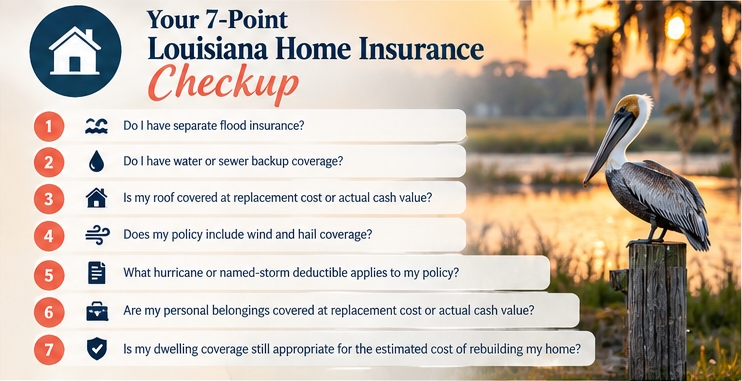
Pull out your homeowners insurance declarations page and see whether you can answer these seven questions:
Do I have flood insurance?
Do I have water or sewer backup coverage?
Is my roof covered at replacement cost or actual cash value?
Does my policy include wind and hail coverage?
What is my hurricane or named-storm deductible?
Are my personal belongings covered at replacement cost or actual cash value?
Is my dwelling coverage still enough for the estimated cost of rebuilding my home?
If you cannot confidently answer all seven, that does not automatically mean your policy is bad.
It simply means it may be time to review it.
Homeowners Insurance in Metairie and Greater New Orleans
At Cheek Insurance Services, we help Louisiana homeowners understand what their insurance actually says, not simply what they assume it says.
Our agency is based in Metairie, Louisiana, and understands the insurance concerns homeowners throughout the Greater New Orleans area and Louisiana face, from hurricanes and wind to flooding and changing property insurance needs.
A policy review can help you understand your existing coverage, deductibles, limits, exclusions, and available options before you need to file a claim.
If you live in Metairie, New Orleans, Jefferson Parish, or elsewhere in Louisiana and have questions about your homeowners or flood insurance, contact Kati Cheek and the Cheek Insurance Services team to review your options.
The goal isn't simply to have an insurance policy.
It's to know what that policy is designed to protect before you need it.
Frequently Asked Questions About Louisiana Homeowners Insurance
Does homeowners insurance cover flooding in Louisiana?
Most homeowners insurance policies do not cover flood damage. Louisiana homeowners can purchase separate flood insurance through the National Flood Insurance Program, private flood insurers, or certain surplus lines insurers. Even homes outside high-risk flood zones can experience flooding.
Does homeowners insurance cover hurricane damage in Louisiana?
It depends on the cause of the damage and the policy. Wind damage may be covered under a homeowners or separate wind policy, while flooding and storm surge generally require flood insurance. Some policies, particularly in coastal areas, may exclude wind and hail coverage.
Does homeowners insurance cover roof replacement in Louisiana?
A homeowners policy may cover roof damage caused by a covered peril, but how much the insurer pays depends on the policy. Roofs may be covered using replacement cost or actual cash value, and some policies contain additional roof limitations or special deductibles.
What is a hurricane deductible in Louisiana?
A hurricane or named-storm deductible is a separate deductible that may apply when covered damage results from a qualifying storm. It may be calculated as a percentage of the home's insured value rather than as a fixed dollar amount.
For example, a 5% deductible on a home insured for $300,000 would equal $15,000.
Do I need flood insurance if I'm not in a high-risk flood zone in Louisiana?
Flood insurance may not be required by your lender if your property is outside certain high-risk flood areas, but that does not mean the property has no flood risk. NFIP data shows that flood claims also occur outside designated high-risk areas.
What is the difference between replacement cost and actual cash value?
Replacement cost generally reflects the cost to replace damaged covered property with comparable property, subject to policy terms and limits. Actual cash value generally subtracts depreciation for factors such as age, wear, and tear.
What should Louisiana homeowners review before hurricane season?
Homeowners should review their dwelling limit, flood coverage, wind and hail coverage, roof settlement terms, personal property coverage, hurricane or named-storm deductible, and other applicable endorsements or exclusions before a storm threatens Louisiana.
About Kati Cheek
Kati Cheek is the owner of Cheek Insurance Services in Metairie, Louisiana. Kati and her team help Louisiana residents better understand their insurance options and protect the homes, vehicles, and property that matter to them.
Cheek Insurance Services
4515 Shores Dr., Suite 102
Metairie, LA 70006
Phone: (504) 455-1234
Insurance coverage is subject to the terms, conditions, exclusions, deductibles, and limits of the individual policy. Coverage availability varies by insurer and property. This article is provided for general educational purposes and does not modify or replace the terms of any insurance policy.